
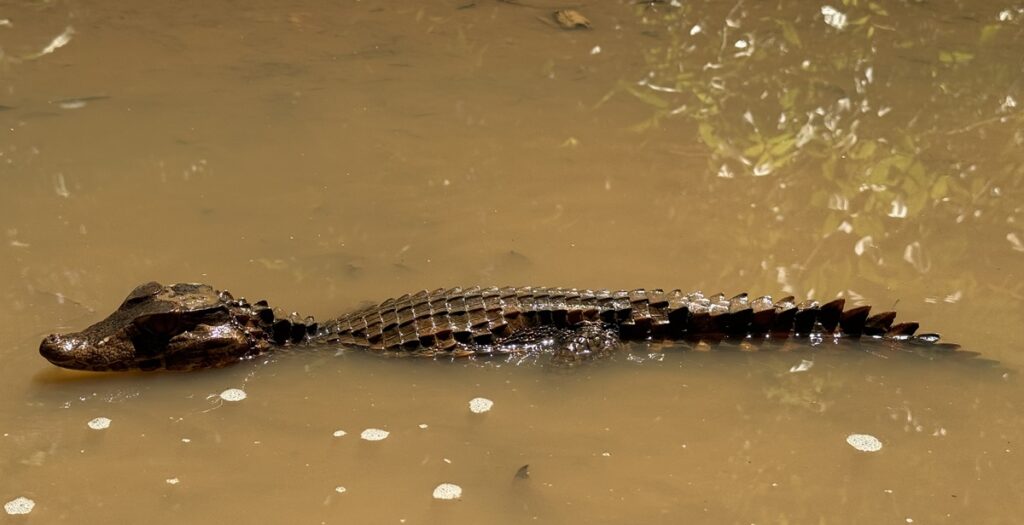
Sit quietly on the edge of a creek in the Suriname interior after sunset, switch on a flashlight, and sweep the beam low across the black water. Somewhere out there, a pair of orange-red points will glow back at you; the reflected eyeshine of a caiman, floating motionless with only its eyes and nostrils above the surface, waiting. It is a scene that has played out in these rivers, swamps and coastal lagoons for tens of millions of years, largely unchanged. Caimans are not a footnote in Suriname’s biodiversity story; they are one of its headline acts, and they belong to a lineage that has outlasted the dinosaurs they are so often compared to.
Suriname, with 93% of its land still under forest cover and a river system that laces through nearly every district, is genuinely excellent caiman country. Four distinct species share this small country’s wetlands, swamps, blackwater creeks, flooded forests and coastal lagoons — more caiman diversity, in fact, than almost anywhere else on the continent. For a biologist, that is remarkable. For a traveller, it means a single trip to Suriname can realistically put you face to face with everything from a two-foot dwarf caiman tucked under a fallen log to a four-metre black caiman cruising a jungle river at dusk.
This article is an introduction to those four species: who they are, how they have managed to survive essentially unchanged since the age of reptiles, and the more complicated reality that in Suriname, caimans are not only watched and studied — they are, in certain communities and contexts, also eaten. Understanding that fact, rather than looking away from it, is part of understanding how Surinamers actually live alongside these animals.
A Very Old Family Tree
Caimans are crocodilians, in the same order as crocodiles, alligators and gharials, but they sit in their own family branch — the Alligatoridae, which they share with the American and Chinese alligators. Structurally, a caiman is built almost exactly like its Cretaceous ancestors: a flattened, streamlined body for cutting through water with minimal resistance, eyes and nostrils raised on top of the skull so the animal can see and breathe while the rest of it stays submerged and invisible, powerful laterally-flexing tails that provide nearly all of their swimming propulsion, and jaws lined with conical teeth built for gripping and holding rather than chewing. It is a body plan that has needed almost no revision in over 80 million years, because it was already close to perfect for an ambush predator that hunts at the boundary between water and land.
What distinguishes caimans from their crocodile cousins is mostly in the details. Caimans have bony plates called osteoderms embedded in their belly scales as well as their backs — a feature crocodiles lack — which historically made caiman leather less prized by the tanning trade than crocodile or alligator hide, and incidentally gives living caimans an armour crocodiles don’t have. Caimans also tend to have broader, more U-shaped snouts than true crocodiles, and when a caiman’s mouth is closed, its upper jaw overlaps the lower one so the enlarged fourth tooth is hidden from view — a classic alligatorid trait, and one of the easiest field marks for telling a caiman from a crocodile at a glance (not that you’re likely to need it in Suriname, which has no native crocodile species).
The Four Caimans of Suriname
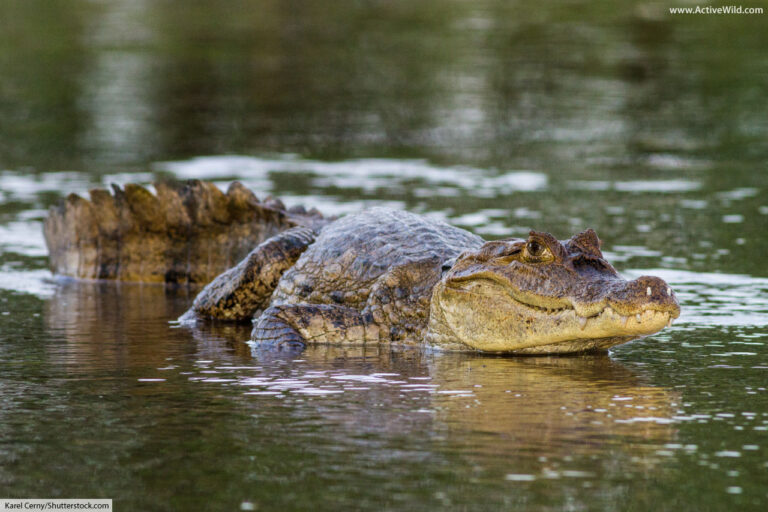
The Spectacled Caiman (Caiman crocodilus)
If you go looking for a caiman anywhere in Suriname’s lowlands, this is the one you are most likely to find. The spectacled caiman is the most widespread and adaptable of the four species, equally at home in slow blackwater creeks, rice paddy canals, coastal lagoons like Bigi Pan, and the flooded forest pools of nature parks like Peperpot, just outside Paramaribo. It takes its common name from a bony ridge between the eyes that, on some individuals, gives the face a faint resemblance to a pair of spectacles.
Adults typically reach 1.5 to 2 metres, occasionally larger, with olive-green to greyish-green colouring that provides excellent camouflage among floating vegetation and murky water. It is a generalist hunter with a genuinely broad diet — fish, crabs, insects, amphibians, birds and small mammals are all fair game, and larger individuals will readily take prey as big as capybara or even other, smaller caimans. That adaptability, both in habitat and diet, is exactly why the spectacled caiman has managed to remain the most abundant crocodilian across almost its entire range, from southern Mexico down through Central America and into much of northern South America, even in areas where human pressure has pushed other wildlife into retreat.
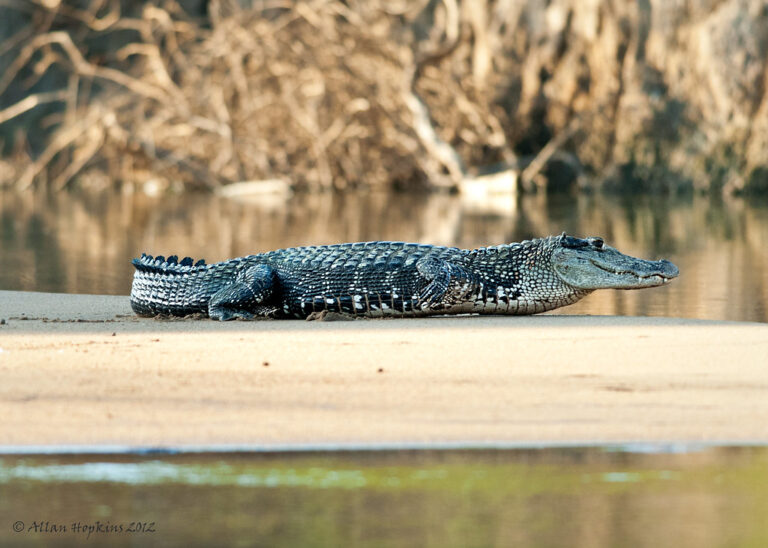
The Black Caiman (Melanosuchus niger)
This is the giant of the family, and one of the largest predators in South America. Black caimans can reach 4 to 5 metres in length and, in exceptional cases, considerably more — historical records claim individuals close to 6 metres, though animals over 4.5 metres are now rare almost everywhere, Suriname included, largely as a legacy of decades of hide hunting across the Amazon basin in the twentieth century. Where the spectacled caiman is a generalist of open, sunlit waters, the black caiman favours slower, darker, more secluded stretches of river and flooded forest in Suriname’s interior, and it is largely nocturnal, which is part of why encountering one feels like such a privilege rather than a routine sighting.
As the name suggests, adults are dark, almost black, with faint pale banding that is more visible on juveniles and fades with age — useful camouflage in the tannin-stained blackwater rivers of the Guiana Shield. Size alone changes everything about a predator’s ecological role: a black caiman of this scale is one of the very few animals in the Suriname rainforest capable of preying on adult capybara, large fish like arapaima, and even jaguars have been documented losing confrontations with big individuals. The black caiman was hunted heavily for its hide through the mid-twentieth century and suffered serious population declines across the Amazon basin as a result; it is currently assessed as Least Concern by the IUCN thanks to recovery in protected populations, but that recovery is real precisely because hunting pressure has eased in many areas, and it remains a species worth watching carefully rather than taking for granted.
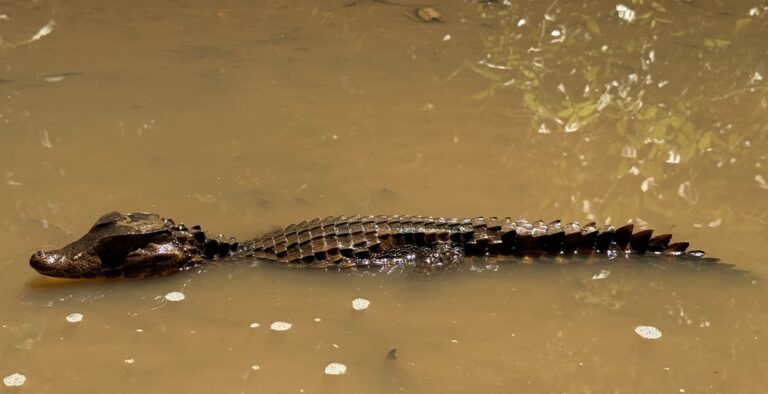
Cuvier’s Dwarf Caiman (Paleosuchus palpebrosus)
At the opposite end of the size spectrum is Cuvier’s dwarf caiman, the smallest living crocodilian on Earth. Males rarely exceed 1.4 metres and females are smaller still, yet what this species lacks in size it makes up for in sheer toughness. Dwarf caimans are heavily armoured, with thick, bony osteoderms covering almost the entire body, and they favour fast, cool, well-oxygenated headwater streams and rocky creeks — habitats other caiman species tend to avoid. In Suriname, this makes them a genuine reward for travellers who make it into the true interior: rapids-strewn rivers near places like Brownsberg or the upper Suriname River are classic dwarf caiman territory.
They are also remarkably self-sufficient diggers. Cuvier’s dwarf caimans excavate burrows in riverbanks and will retreat into them during periods of low water or cooler weather, a behavioural adaptation that helps buffer them against Suriname’s dry-season fluctuations far better than their larger, more water-bound relatives. Their diet leans heavily on crustaceans, fish and insects, reflecting a body built more for manoeuvring through tight, rocky, fast-flowing spaces than for the open-water ambush hunting of a spectacled or black caiman.
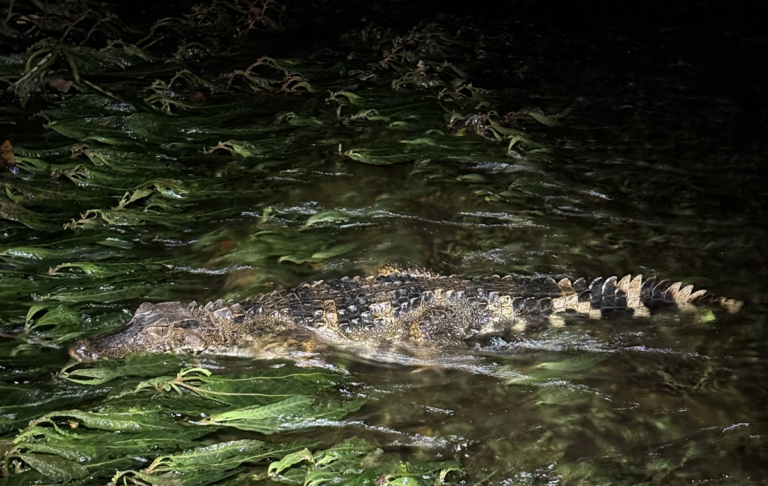
The Smooth-fronted Caiman (Paleosuchus trigonatus)
The fourth species, sometimes called Schneider’s dwarf caiman, is Cuvier’s dwarf caiman’s close cousin and just as easy to overlook, which is precisely the point. Slightly larger than P. palpebrosus but still modest by crocodilian standards, rarely exceeding 1.7 metres, the smooth-fronted caiman is the most terrestrial and forest-adapted caiman in South America. It is often found well away from open water, in small forest streams, seasonal pools and even damp leaf litter deep in primary rainforest, and it is comfortable making significant overland journeys between water sources — a trait almost unheard of elsewhere in the crocodilian world.
Its colouring, dark brown to almost black with faint mottling, is a near-perfect match for the shaded, leaf-strewn understory it favours, and its low-key lifestyle likely explains why it is one of the least-studied crocodilians on the planet relative to how widespread it actually is across the Guiana Shield and Amazon basin. In Suriname’s remote, well-forested interior, it is probably far more common than sighting records suggest; it is simply extremely good at not being seen.
How Caimans Survive: Fifty Million Years of Getting It Right
The persistence of caimans through such enormous stretches of geological time is not an accident. It reflects a genuinely elegant set of biological solutions to the core problem every ectotherm in the tropics has to solve: how to hunt, grow, reproduce and avoid becoming prey yourself, all while your body temperature and metabolism are directly at the mercy of your environment.
Cold-bloodedness as an advantage, not a limitation. Being ectothermic — unable to generate their own body heat internally — is often framed as a weakness, but for an ambush predator it is close to a superpower. A caiman can go weeks between meals if it needs to, expending a tiny fraction of the energy a warm-blooded predator of equivalent size would burn just staying alive. That efficiency lets caimans persist through lean periods, seasonal droughts and prey scarcity that would starve out a comparably sized mammal, and it means a large black caiman can afford to remain motionless for hours, conserving every calorie until the right prey animal drifts within range.
Camouflage and stillness. Every caiman species in Suriname relies on some version of the same trick: eyes and nostrils positioned at the very top of the skull, allowing the animal to see, breathe and detect vibration while the rest of the body stays submerged and essentially invisible. Combined with mottled, water-matching colouration and an almost supernatural capacity for stillness, this turns caimans into ambush specialists that let prey come to them rather than expending energy chasing it down.
Armour. The bony osteoderms embedded throughout caiman skin, especially pronounced in the two dwarf caiman species, provide genuine physical protection against predators, rivals and the abrasive rocky streambeds that Cuvier’s dwarf caiman in particular calls home. This is a defence layered directly into the skin itself, requiring no behavioural effort to maintain.
Buoyancy and stealth engineering. Caimans control their position in the water column with remarkable precision, partly by adjusting lung volume and partly through the movement of the liver, which acts almost like a piston to shift the animal’s centre of buoyancy forward or backward. This lets a caiman hover at a chosen depth, rise silently to just below the surface, or sink out of sight in a moment, all without the tell-tale splashing that would alert nearby prey — or a predator.
Nest-building and parental care. Unlike most reptiles, caimans build nests and actively guard them. Female caimans — and in some species, both parents — construct mounds of vegetation and mud in which eggs incubate, generating heat as the plant material decomposes, not unlike a garden compost pile. Mothers remain near the nest for the roughly three-month incubation period, defending it from predators including tegu lizards, coatis and other opportunists that would happily raid it for eggs. When hatching begins, the young caimans call from inside their eggs, and the mother responds by excavating the nest and, in many species, carrying newly hatched young to the water in her mouth — a strikingly gentle behaviour from an animal so often stereotyped as purely fearsome.
Temperature-dependent sex determination. As with most crocodilians, the sex of a caiman is not fixed genetically at fertilisation but determined by the temperature inside the nest during a critical window of incubation. Warmer nest cores tend to produce males, cooler zones tend to produce females — meaning nest placement and the exact mix of sun, shade and vegetation a mother chooses has real, measurable consequences for the sex ratio of her offspring and, over time, for local population dynamics.
Adaptation to the dry season. Suriname’s pronounced wet and dry seasons put real pressure on any animal tied to standing water. The two dwarf caiman species deal with this by digging burrows into riverbanks, retreating underground when water levels drop and emerging once conditions improve — essentially waiting out the hardest months in a self-made shelter. Spectacled caimans, in areas where pools shrink dramatically, are known to concentrate in the deepest remaining water and become considerably more tolerant of close company with other caimans than they would be under normal circumstances, a rare truce driven by shared necessity.
Together, these adaptations explain why caimans persisted through mass extinctions that eliminated the dinosaurs themselves: a body and a behavioural toolkit built around patience, efficiency and defence rather than speed or raw aggression turns out to be an extraordinarily durable evolutionary strategy.
Ecosystem Engineers, Not Just Predators
It is worth pausing on why caimans matter beyond their own survival. As mid- to top-level predators, caimans exert real, measurable control over fish and invertebrate populations in the waters they inhabit, which in turn shapes the health of the entire aquatic food web beneath them. Where caiman populations have collapsed elsewhere in South America due to overhunting, researchers have documented cascading effects: fish populations booming unsustainably in the short term, then crashing as prey species overwhelm the available food supply, followed by broader disruptions to water quality and aquatic plant life.
Caimans are also, in a very literal sense, ecosystem engineers. The burrows that dwarf caimans dig into riverbanks are frequently reused by other wildlife once vacated. Nest mounds enrich localised soil nutrients as they decompose. And during Suriname’s driest months, the deeper pools that caimans occupy and, in some cases, help maintain by their movement through them, can become refuges not just for the caimans themselves but for fish and other aquatic species riding out the drought alongside them. Pull caimans out of a river system, and the consequences ripple outward in ways that are easy to underestimate from the riverbank.
An Uncomfortable but Important Truth: Caimans Are Also Food
Here is the part of the caiman story that tourist brochures often leave out, and that a serious account of these animals in Suriname shouldn’t avoid: caimans are, and long have been, a source of food here.
In Suriname’s interior, among Maroon communities along rivers like the Suriname and Saramacca, and among Indigenous communities in areas such as Galibi and along the upper rivers, caiman meat has traditionally been part of the diet, hunted much as fish, bush pig, or agouti are hunted — as one protein source among several available from the surrounding forest and rivers, rather than as a rare delicacy. Caiman is also, at times, sold and prepared in and around Paramaribo, where it can turn up in markets or be prepared by cooks familiar with interior cuisine, usually cut into pieces and stewed, smoked, or grilled with the same spices used across Suriname’s varied culinary traditions. The meat itself is pale, lean and mild, generally compared by those who eat it to a cross between chicken and firm white fish — a description echoed by people who eat caiman across much of tropical South America, from the Amazon basin to Colombia’s llanos, where caiman meat remains a genuinely mainstream regional food rather than a novelty.
This practice deserves to be understood in context rather than judged from outside it. For communities living directly off the rivers and forests of the interior, wild protein sources including fish, game and, yes, caiman have historically been not a lifestyle choice but a practical necessity, tied to seasonal availability and centuries of accumulated ecological knowledge about which animals can be harvested sustainably and which cannot. The spectacled caiman, being the most abundant and fastest-reproducing of Suriname’s four species, has generally borne the brunt of subsistence hunting, while the much rarer black caiman — slower to mature, producing fewer offspring relative to the pressure a large-bodied predator can sustain — warrants considerably more caution, and its hunting and trade is subject to international regulation under CITES alongside domestic wildlife law.
This is also precisely why responsible ecotourism and conservation-minded education matter so much here. Suriname’s caiman populations are, by regional standards, in comparatively good shape, largely because the country’s low human population density and enormous unbroken forest cover have kept hunting pressure well below the levels that devastated caiman and crocodile populations in more densely settled parts of South America through the twentieth century. Keeping it that way means supporting regulated, sustainable practices rather than pretending traditional harvesting doesn’t happen, and it means channelling tourism revenue toward valuing caimans alive — as a draw for wildlife travellers, a research subject, and a functioning part of the ecosystem — in ways that reinforce rather than undercut the sustainable practices many interior communities already follow.
Where to See Them
For travellers, Suriname offers a genuinely rare chance to encounter multiple caiman species within a single trip. Bigi Pan, the country’s largest lagoon system on the northwest coast, is one of the most reliable places to spot spectacled caimans, often alongside scarlet ibis and flocks of migratory shorebirds, particularly on a night boat trip when eyeshine makes them far easier to find than during the day. Peperpot Nature Park, remarkably close to Paramaribo for a former plantation now managed for conservation, offers a good introduction to caiman habitat without requiring a long journey into the interior. For a shot at the two dwarf caiman species and, with real luck and patience, a black caiman, the rocky headwater creeks and quieter river stretches around Brownsberg and further into the interior are the places to focus — exactly the kind of terrain where a knowledgeable local guide, who knows which stretch of river has held a resident caiman for years, makes the difference between a fleeting shape in the water and a proper, unforgettable sighting.
A Living Link to Deep Time
Caimans ask very little of us and offer, in return, a genuinely rare kind of encounter: a direct, living link to an evolutionary lineage that predates almost everything else we associate with the age of dinosaurs, still doing exactly what it has always done, in the same rivers and swamps it has always done it in. Suriname, with its intact forest, its four resident species, and its communities who have lived alongside caimans for generations rather than merely visiting them, is one of the very best places left on Earth to understand what that actually looks like — predator, prey, food source and survivor, all at once, floating just beneath the surface with only two eyes showing.
Curious to see Suriname’s caimans for yourself? Our night boat trips through Bigi Pan and our Peperpot and interior river excursions are built around exactly this kind of wildlife encounter — get in touch and we’ll help you plan the right route for what you want to see.