
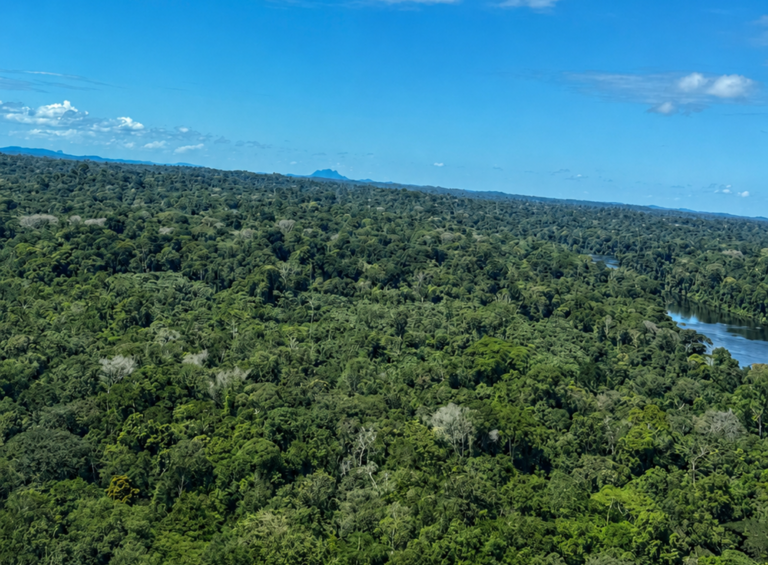
Ask most travellers to name a country in South America and Suriname rarely makes the list. That is, in almost every practical sense, Suriname’s biggest advantage. While its neighbours manage millions of visitors a year across increasingly crowded rainforest circuits, Suriname has quietly built something rarer: a country where 93% of the land is still forest, where the wilderness experience isn’t confined to a park boundary but is simply what the country looks like, and where a visitor is still enough of a novelty that a local guide will treat your trip as a genuine occasion rather than the fortieth group that week. Here’s what actually makes Suriname worth the extra effort to get to and why, for the right kind of traveller, that effort pays off disproportionately.
The most forested country on Earth, by a wide margin
Start with the headline fact, because it’s not marketing exaggeration; it’s UN-verified data. Suriname has 93% forest cover, the highest percentage of any nation on the planet, and a historic deforestation rate of well under 0.1% per year. That makes it the world’s most prominent example of what climate scientists call a “High Forest Cover, Low Deforestation” country, a distinction shared by only a handful of nations worldwide. Suriname’s forests are estimated to lock away more than 900 million metric tons of carbon, and the country is formally recognized as one of only three nations on Earth that are carbon-negative; absorbing more carbon dioxide than its entire economy emits, in a decade when almost every other country is fighting to merely slow its emissions growth.
This isn’t an accident of low development, either; it’s now official policy. At the Global Citizen NOW summit in 2025, Suriname’s government made a formal pledge to permanently protect at least 90% of the country’s forest cover, a target that goes well beyond the international “30×30” biodiversity goal most nations are struggling to hit. Few countries anywhere have made a conservation commitment at that scale relative to their own land area, and fewer still already have the forest cover in place to make good on it.
Wilderness that isn’t confined to a park boundary
Here’s the part that makes Suriname genuinely different from a typical rainforest destination: in most Amazon countries, the “wild” experience is something you drive or fly to, a protected pocket surrounded by farmland, ranching or development. In Suriname, you don’t need to reach a specific park to be surrounded by primary forest; you’re already in it the moment you leave the coastal strip, because the forest simply is the country.
At the heart of that wilderness sits the Central Suriname Nature Reserve, a UNESCO World Heritage Site covering 1.6 million hectares; an area roughly the size of the U.S. state of New Jersey, and equal to 11% of Suriname’s entire land mass. IUCN’s official conservation assessment rates it as being in genuinely pristine condition, and crucially, much of it isn’t just unlogged, it’s unhunted; a rarer and more meaningful distinction than forest cover alone, since hunting pressure can quietly empty out large mammal and predator populations from a forest that still looks intact from above. Inside that single reserve live all eight of Suriname’s monkey species, more than 400 recorded bird species including the harpy eagle and the brilliant orange Guiana cock-of-the-rock, and confirmed populations of jaguar, giant armadillo, giant river otter and tapir; an astonishing concentration of large, charismatic wildlife with no permanent human settlement and zero mining or logging permitted anywhere inside its boundaries.
Zoom out to the national level and the numbers hold up just as well. Suriname has documented roughly 1,890 vertebrate species within its borders — around 750 species of bird, 200 mammals, 152 reptiles, 95 amphibians and 790 fish and researchers openly acknowledge that because so much of the interior remains genuinely unexplored, the true total is likely higher still. The government has already placed 14% of the country’s total land area under formal national protection and has committed to expanding that to at least 17% by 2030, on top of the separate 90% forest-cover pledge — a layered, multi-target approach to conservation that few countries attempt simultaneously. With a national population density of just 2.9 people per square kilometre, among the lowest of any country in the Western Hemisphere, that protected wilderness isn’t a crowded commodity divided among millions of domestic visitors either; it stays exactly as empty, and exactly as wild, as the numbers suggest.
Real solitude: the kind that’s disappearing everywhere else
Numbers make this benefit concrete rather than just a feeling. Suriname, as an entire country, receives roughly 279,000 international visitors a year. Compare that to the Brazilian state of Amazonas alone, home to the city of Manaus, which drew more than 1.17 million visitors in its peak pre-pandemic year; over four times Suriname’s entire national total, from a single regional gateway. Manaus itself is a city of 2.2 million people with a working cruise port that received roughly 10,000 cruise passengers across just eight ship calls in a single recent season.
Suriname simply doesn’t have that kind of tourism machinery, and that absence is the point. There is no assembly-line rainforest experience here; no fixed departure boats loading a hundred passengers at a time, no lodge circuits built for maximum throughput. What you get instead is a guide who knows a specific bend in a specific river personally, because they’ve been going there their whole life, not because it’s stop four on a standardized itinerary. Several independent travel-industry surveys of the world’s least-visited countries include Suriname by name, consistently flagging the same trade-off: the outdoors are extraordinary, and you will very likely have them close to yourself.
A cultural mosaic that exists nowhere else in South America
This is the benefit that surprises first-time visitors most, because it has nothing to do with the rainforest at all. Suriname is a country of roughly 600,000 people with no single ethnic majority: Hindustani Surinamese descended from 19th-century Indian indentured labourers, Maroon communities descended from enslaved Africans who won their freedom and self-governance generations before regional abolition, Javanese Surinamese with roots in colonial-era Indonesia, Afro-Surinamese Creoles, and Indigenous Amerindian nations each make up substantial shares of the population, alongside smaller Chinese, Lebanese and European communities. Dutch is the official language, but Sranan Tongo, Sarnami Hindustani, Javanese, Saramaccan and multiple Amerindian languages are all still spoken daily.
Suriname holds, per capita, one of the largest Hindu populations anywhere in the Western Hemisphere outside India and Guyana. In Paramaribo, a historic mosque and synagogue stand directly beside one another on the same street — a detail locals point to with real pride as a symbol of how the country actually functions. Nowhere else in the Amazon basin will your rainforest guide be as likely to be Saamaka or Ndyuka Maroon, carrying an unbroken, self-governed Afro-descendant culture found nowhere else on the continent, as they are to belong to any other background entirely. That’s not a footnote to the wildlife trip — for a lot of travellers, it ends up being the part they remember most.
Global conservation leadership you can actually feel on the ground
Suriname isn’t a passive beneficiary of its own geography — it has become an increasingly vocal player in global climate diplomacy specifically because of what it has managed to protect. The country hosted the “High Forest Cover, Low Deforestation Conference on Climate Finance Mobilization” in 2019, bringing together the small group of nations that share Suriname’s conservation profile to make the case internationally that keeping forests standing deserves real financial recognition, not just praise. In 2025, Suriname’s leadership took that further with the formal pledge to permanently protect 90% of the country’s forests, alongside updated legislation supporting Indigenous land rights and structured space for sustainable ecotourism. In early 2026, Suriname’s tourism sector went a step further still, championing ecotourism on the global stage at the World Economic Forum in Davos and rolling out “Pramisi” — a national promise to travel sustainably — as a public commitment rather than a marketing slogan.
That matters for a visitor in a very practical way: when you book a tour in Suriname, you’re not just consuming a wilderness experience, you’re participating directly in the economic case the country is making to the rest of the world for why its forests are worth more standing than cleared. Tourism revenue here is a live argument for conservation, not just a byproduct of it.
The commitments extend beyond forestry, too. Suriname’s national climate plan includes maintaining renewable electricity generation above 25% and specific targets for climate resilience across agriculture and transport — a small country nonetheless setting itself formal, trackable benchmarks in almost every sector its own development touches. For a nation with a GDP a fraction of its larger neighbours’, that’s a disproportionate level of institutional commitment, and it’s exactly the kind of detail that turns a wildlife trip into something a traveller can feel genuinely good about funding.
Genuinely reachable, despite the reputation
“Remote” doesn’t have to mean “hard to get to,” and Suriname’s connections are better than its off-the-radar reputation suggests. Surinam Airways runs a direct flight from Miami to Paramaribo, putting the whole country within a single flight of the United States. KLM and Surinam Airways both operate direct service from Amsterdam, a legacy of Suriname’s history as a Dutch colony that today means easy onward connections throughout Europe. And for travellers coming from Brazil, there’s a direct twice-weekly flight connecting Paramaribo with Belém — the very city hosting COP30, putting Suriname a short hop from one of the Amazon basin’s biggest transport hubs. Direct Amsterdam–Paramaribo service, briefly disrupted, is back and running as of 2026, restoring the easiest European gateway into the country.
Once you land, Suriname compresses an enormous amount of variety into a small footprint. Paramaribo’s UNESCO-listed wooden inner city, Peperpot Nature Park’s birding trails, and the flamingo-dotted wetlands of Bigi Pan are all within striking distance of the capital, while Brownsberg, the Central Suriname Nature Reserve and the Maroon river villages of the deep interior are a short flight or boat journey beyond that. Few countries let you move from colonial architecture to genuine untouched rainforest in the course of a single week.
A safety profile that quietly outperforms its reputation
Because Suriname is so unfamiliar to many travellers, safety concerns are often the first hesitation and the real numbers are reassuring. The United States, Canada and Australia all rate Suriname at Level 1, “Exercise Normal Precautions,” their lowest risk category, the same rating given to dozens of well-established travel destinations worldwide. The country has a low terrorism risk, no history of attacks, and no known extremist activity operating within its borders. As with any capital city, Paramaribo carries the ordinary urban precautions familiar to travellers anywhere; situational awareness after dark, reputable transport, the usual pickpocket vigilance in busy markets; but violent crime targeting tourists specifically is uncommon. Suriname also received WHO malaria-free certification in mid-2025, a genuinely significant public health milestone for a country with this much rainforest, even though standard precautions for other vector-borne illnesses in the interior remain sensible.
Put plainly: the real risk profile of a Suriname trip looks a great deal like visiting any other Latin American capital with a rural extension, not the exotic hazard the country’s obscurity might suggest.
Wildlife encounters that feel earned, not staged
Because Suriname’s tourism sector hasn’t industrialized, wildlife encounters here tend to carry a different weight than the reliably scheduled sightings common on high-volume Amazon circuits elsewhere. This is a country with four distinct species of caiman living across its rivers, swamps and lagoons; the widespread spectacled caiman, the giant black caiman, and two remarkable dwarf species found only in the region’s fastest, most pristine headwater streams; along with confirmed jaguar populations, giant river otters, harpy eagles, eight species of primates, and the extraordinary Guiana cock-of-the-rock, all recorded within a single UNESCO-protected reserve. A night boat trip through Bigi Pan regularly turns up scarlet ibis and flocks of migratory shorebirds alongside caiman eyeshine glowing across the water; a morning at Peperpot, a former plantation now managed for conservation just outside Paramaribo, can deliver serious birding without ever leaving the greater capital area.
None of this is guaranteed, and no honest guide will promise otherwise; wildlife never works on a schedule. But the forest doing the delivering here is, by international measure, some of the least disturbed left anywhere on the continent, and that difference shows up in what you’re actually likely to see.
Real, homegrown conservation science
Suriname’s forests aren’t just admired from a distance; they’re actively studied by Suriname’s own institutions, not merely visited by outside researchers passing through. The Centre for Agricultural Research in Suriname (CELOS), affiliated with the Anton de Kom University of Suriname in Paramaribo, has run continuous forestry and biodiversity research since 1967 — longer than most of the international conservation organizations now active across the wider Amazon basin have even existed. International partners, including Michigan Technological University, now run field research programs directly through CELOS rather than around it, training the next generation of tropical forestry and conservation scientists on Surinamese soil, guided substantially by Surinamese expertise. That’s a meaningfully different conservation story than a purely externally-funded research outpost, and it means the country’s environmental leadership on the world stage is backed by decades of its own scientific infrastructure, not borrowed credibility.
An enormous amount of variety in a very small footprint
Because Suriname is compact; smaller in land area than the U.S. state of Georgia; it manages to compress an unusual range of experiences into distances that would barely register in Brazil or Peru. A single week can realistically move from the colonial wooden architecture of Paramaribo’s UNESCO-listed inner city, through the birding trails of Peperpot Nature Park and the flamingo-dotted wetlands of Bigi Pan, to the waterfalls and viewpoints of Brownsberg, and on into the deep interior along rivers like the Gran Rio, without the multi-day transfers that similar variety would demand almost anywhere else on the continent. Few rainforest destinations let a traveller genuinely combine city, coast, savanna and untouched interior forest inside a single, unrushed itinerary; Suriname’s small size, normally treated as a limitation, turns out to be one of its more practical advantages.
A cuisine and culture you can taste, not just observe
Suriname’s cultural diversity isn’t confined to festivals and languages — it shows up on every plate. A single meal here might draw from Javanese, Hindustani, Creole, Chinese and Indigenous culinary traditions simultaneously, a genuine reflection of how thoroughly these communities have blended over generations while still maintaining distinct identities. Pom, widely regarded as Suriname’s national dish, traces back to Portuguese-Jewish plantation owners adapting a European potato bake using arrowleaf elephant ear root grown locally — a dish now claimed proudly across the country’s Creole and Jewish communities alike, and popular enough that it has followed the Surinamese diaspora to more than 120 restaurants and eateries in Amsterdam alone. Roti and saoto soup sit on the same street-food menus as Javanese bakmi and Creole-style grilled fish, often prepared within a few storefronts of each other in Paramaribo’s central markets, and it’s entirely normal for a single family gathering to mix dishes from three or four of these traditions without anyone treating that as unusual. That’s the Suriname pattern in miniature: colonial history, migration, and genuine cultural fusion, turned into something distinctly its own rather than a simple import from any single origin.
The honest trade-off, and why it’s worth making
None of this means Suriname is effortless. Tourism infrastructure here remains genuinely boutique rather than industrial, which means prices can run higher than the equivalent experience in a more established rainforest destination, and travel into the interior depends far more heavily on a specific guide’s knowledge than on a large substitute system standing behind them. Domestic flights into the interior are small-aircraft operations rather than scheduled jets, river travel runs on water levels and local timing rather than a printed schedule, and a trip here rewards travellers who value flexibility over rigid itineraries. That’s precisely the trade a traveller is making, and it’s worth naming honestly rather than glossing over.
But weighed against what Suriname offers in return — a national forest-cover percentage no other country on Earth can currently match, a genuinely uncrowded and largely unhunted wilderness at a country-wide scale, nearly 1,900 recorded vertebrate species and counting, a cultural mosaic unlike anywhere else the Amazon basin has to offer, real conservation leadership backed by homegrown science, and safety and accessibility numbers that outperform the country’s own quiet reputation — it’s a trade an increasing number of serious travellers are deciding is well worth making. Suriname isn’t trying to be the next Manaus or the next Iquitos, built for scale. It’s staying exactly what it already is: the most forested country on Earth, and one of the very few places left where that claim is still something you can walk, paddle and fly directly into.
So, really; should you just go?
Strip away every statistic in this article for a moment, because none of them are actually why people fall in love with a place. Here’s the plainer version: there is a country, a few hours from Miami and a single flight from Amsterdam, where you can watch the sun come up over a river with nobody else’s boat in sight, where a Maroon guide who has known that stretch of water his entire life will cut the engine so you can hear the forest actually wake up, where a jaguar’s tracks in the mud are still something to point at and go quiet over rather than a photo op ticked off a list. That country exists right now, today, not in some hypothetical “before the crowds arrived” version of the past. Most of the truly wild places left on Earth are wild because they’re hard to protect. Suriname is wild because it’s still, genuinely, mostly forest — and that’s not a state that lasts forever anywhere, which is exactly why the honest advice is not “someday” but “soon.”
You don’t need to be a serious birder, a conservation scientist, or a hardened backpacker to feel the difference here. You need to be a person who’s tired of visiting the “authentic” version of somewhere that’s secretly built for a hundred tour buses a day, and who’d rather have one real, quiet, slightly imperfect morning on a blackwater river than ten polished, crowded ones anywhere else. If that’s you, the facts in this article aren’t really the reason to come. They’re just confirmation, after the fact, that the instinct was right. Suriname doesn’t need you to be convinced by a spreadsheet. It just needs you to show up.
Ready to see what 93% forest cover actually looks like on the ground? Our Suriname itineraries are built around exactly this — get in touch and we’ll help you plan a trip through the wooden city of Paramaribo, the wetlands of Bigi Pan, and deep into the Central Suriname Nature Reserve.