
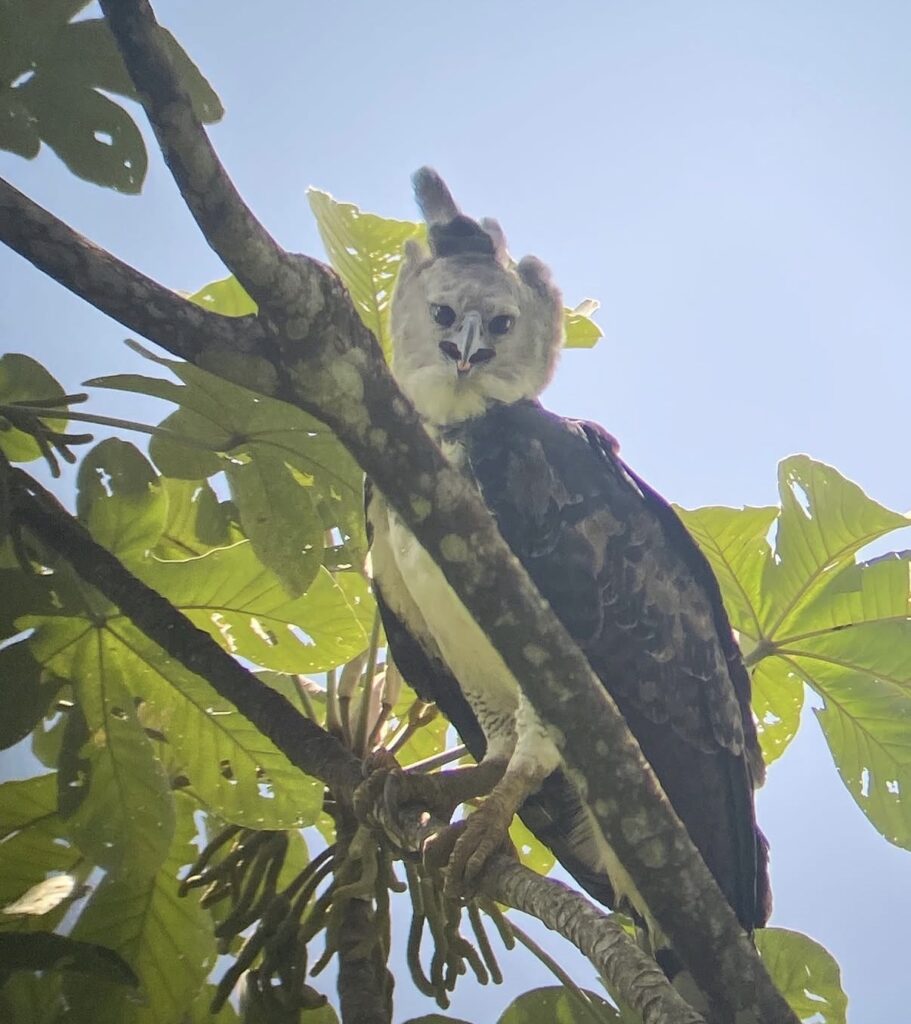
Deep within the emerald cathedral of Suriname’s Amazon, where sunlight filters through layers of leaves in shifting golden shafts, reigns a predator so powerful and so elusive that even seasoned birdwatchers travel thousands of miles just for a glimpse. This is the Harpy Eagle — Harpia harpyja — and to see one in the wild is to witness one of nature’s most extraordinary success stories.
A Bird Built Like a Legend
Don’t let the word “eagle” fool you into imagining something familiar. The Harpy Eagle is a creature of startling proportions. Females can weigh up to 9 kilograms with a wingspan stretching over two meters, and their legs are as thick as a child’s wrist, tipped with talons longer than a grizzly bear’s claws. A striking grey facial disc frames piercing eyes, topped by a double crest of feathers that rises when the bird is alert — giving it an almost regal, crown-like silhouette.
Suriname: One of the Last True Strongholds
While Harpy Eagles once ranged from Mexico to Argentina, deforestation has erased them from much of that territory. Suriname remains different: despite being the smallest nation on the continent, it boasts the highest percentage of forest cover of any country on Earth, enveloping roughly 93% of its territory. That intact wilderness is exactly what a top predator like the Harpy Eagle needs, since nesting pairs require enormous, undisturbed hunting territories.
The Silent Hunter
Don’t expect dramatic soaring overhead. Harpy Eagles hunt with stealth, perching motionless for hours before exploding into a burst of speed to snatch sloths, monkeys, and other canopy dwellers directly from the treetops. Spotting one usually means quiet observation, a patient guide, and a great deal of luck — precisely what makes the encounter so unforgettable.
Where to Find Suriname’s Harpy Eagle
Central Suriname Nature Reserve is the crown jewel for any Harpy Eagle search. This UNESCO World Heritage Site protects 1.6 million hectares of primary tropical forest in west-central Suriname, and among its 400 recorded bird species is the charismatic Harpy Eagle, alongside jaguars, giant river otters, and eight species of primate.
Within the reserve, Raleighvallen (Raleigh Falls) and the Voltzberg area form one of the best places for birders, with a species checklist exceeding 460 birds, including birds of prey such as the Harpy Eagle. The Raleighvallen area is the most popular entry point into the reserve, offering both research stations and eco-lodge accommodation, with travel by dugout canoe as the primary way to get around. A small research station near the granite Voltzberg dome offers hammock accommodation, putting you in position at dawn and dusk — the best times to catch movement in the canopy.
Further into the deep interior, the remote Kabalebo Nature Reserve, reachable only by small aircraft with the nearest road more than 150 kilometers away, is another region where sightings occur. Guides and travelers have also reported Harpy Eagle encounters around Bigi Poika and community-based expeditions in the western interior, where night stays in the swamp and boat trips through the jungle add to the sense of true wilderness immersion.
For those with less time, Brownsberg Nature Park, roughly 150 km south of Paramaribo and reachable by road in about two hours, offers a more accessible taste of Suriname’s rainforest — though Harpy Eagle sightings here are rarer than in the deeper interior.
Most Harpy Eagle expeditions are arranged through specialist operators in Paramaribo, since access to these reserves typically requires small aircraft transfers or multi-day river journeys by boat.
A Symbol Worth Protecting
Encountering a Harpy Eagle is more than a checklist moment for birdwatchers — it’s a reminder of what an intact rainforest ecosystem can still hold. For travelers seeking Suriname’s wildest secrets, the Harpy Eagle stands as the ultimate reward: patient, powerful, and utterly wild — the true king of the canopy.